


Spatial AI in Canada moving from digital to physical
Thu, 1st Oct 2026 (Today)
Spatial AI is not just world models or simulations.
The term is increasingly being applied to physical environments, but the technologies behind the label being developed in Canada can differ substantially.
One company in Canada's AI capital, Toronto, and another on the West Coast in Vancouver are innovating in this part of the AI sector, whether finding the optimal route for a hospital's lifeline systems or guiding an autonomous pod from airport security to a gate.
Francesco Iorio, Co-Founder & CEO of Augmenta, a spatial AI infrastructure firm designing electrical routes from hospitals to data centres, said his firm has developed its own representations of buildings and construction processes, along with its machine-learning architecture and systems for generating synthetic training data. Those simulation environments allow the company to train its models across different building types rather than waiting for every possible structure to appear as a customer project.
The firm has around 70 projects completed or underway. Last year, the company initiated the first building in the United States to feature a complete electrical system designed by artificial intelligence at an elementary school in Michigan.
Iorio argued that existing foundation and world models have limitations when required to perform complex spatial reasoning at scale, particularly for long-horizon tasks such as designing an entire building or infrastructure project.
Augmenta's answer is to build its own models. Iorio describes them as a hybrid: "a combination of machine learning principles and symbolic computation, actual mathematics and physics."
The company has its own way of representing a building digitally, including how it is constructed, how it is scheduled and how its systems work together. It also designs its own machine learning architectures, which Iorio calls its "secret sauce." Real design data is scarce, so Augmenta built simulation environments that generate synthetic data. That data gets the models started, and from there they keep training themselves. As a result, Iorio said, the system can handle building types it hasn't seen before.
"In that sense, we have taken essentially the time and the effort to essentially create the foundation models and algorithms that can tackle a large variety of buildings. Otherwise, if we had to wait for those buildings to let's say, show up for us to be able to deploy the technology, it would be very inconvenient."
Augmenta's technology has to fit into an industry where buildings involve multiple stakeholders, from architects and engineering firms to general contractors, subcontractors and trades. The value of spatial AI therefore depends partly on how effectively it can connect with the digital processes those organisations already use.
That creates an interesting challenge for Canada.
Augmenta's first projects have been in the United States. Iorio attributes that partly to the greater digital maturity of U.S. architecture, engineering and construction organisations, particularly their adoption of BIM and related digital processes. He argued that Canada has lagged the U.S. in the widespread adoption of digital technologies for design, engineering and fabrication.
The issue is not simply whether a Canadian company can build the technology. It is whether the organisations that need to use it have the digital infrastructure and processes required to deploy it.
Iorio expects that to change as demand grows, particularly around mission-critical infrastructure, data centres and other large projects.
"The level of digital readiness is not just the market size, if you will, but the level of digital sophistication of engineering firms and contractors and GCs in the United States is quite a bit kind of farther out than Canada," said Iorio. "Canada, I would say, is about five to six years behind in the general diffusion of full digital technologies for design, engineering, and fabrication, and so we chose essentially the more mature [option]."
A 2025 National Research Council of Canada report on BIM adoption similarly identified inconsistent adoption rates across Canadian firms, regions and project types, while pointing to fragmented processes and the need for a more unified approach to BIM maturity.
Across the country, Jessica Yip's company A&K Robotics, of which she is Co-Founder and COO, is being deployed at Vancouver International Airport, where its autonomous mobility pods operate in an environment that can change rapidly. The company started ten years ago focused on the core technology of autonomous navigation. This included building the architecture for its Cruz Mobility Pod through real-time three-dimensional LiDAR systems.
A gate can become crowded within minutes, construction can alter a route, or a new shop can appear in a previously mapped area.
"We use all of the same sensors that Waymo uses, except when you're indoors, you're not going to rely on GPS. So how we solve for that is that we map the airport. Any new site that we go into, we start by mapping it, and over these years we've made that increasingly more efficient and increasingly being able to handle spaces that are challenging for robots," said Yip, adding that initial airport mapping can take as little as half a day.
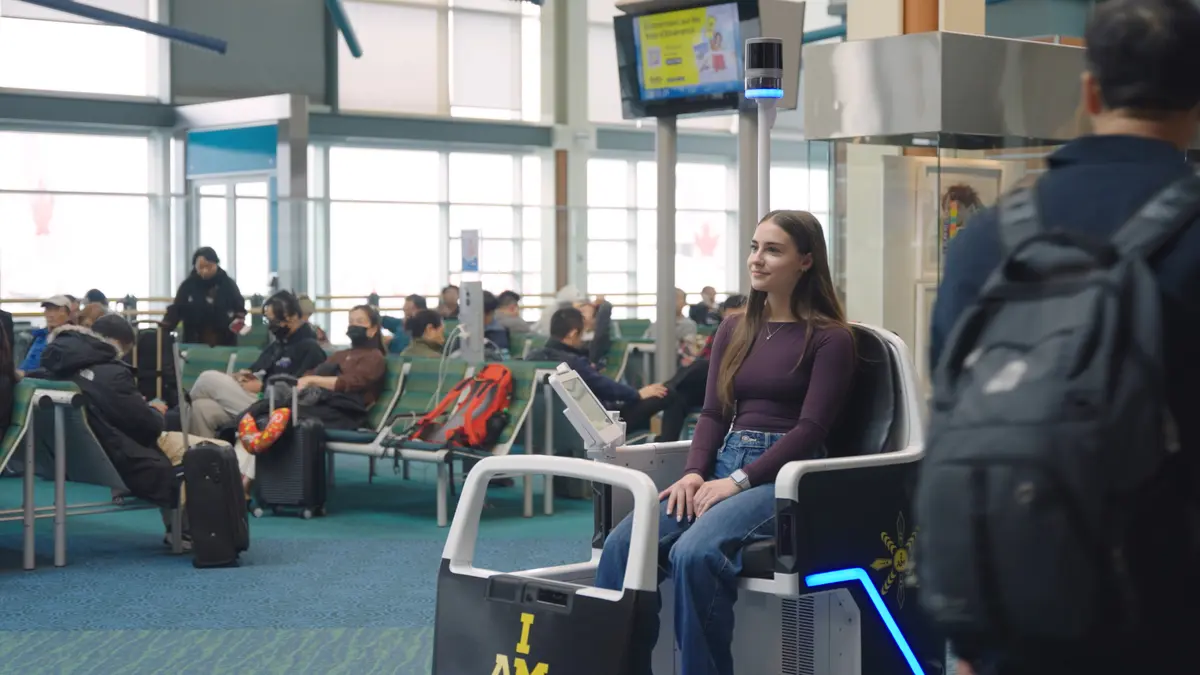
Its system initially maps a new site, but then has to determine which changes are temporary and which should become part of its understanding of the environment. A person standing in a walkway can simply be avoided; a new semi-permanent object may need to be incorporated into the map. Fleets can also use congestion information to alter their routes.
"In the future, I believe that we'll have our pods available, so somebody can call it from anywhere in the airport. So we're building all of these different integration systems, in addition to putting this technology out there, because what we want to make is a new form of airport infrastructure that is smarter."
A&K is similarly looking beyond airports. Its navigation technology is intended to operate in other complex indoor environments, including conference centres and sports stadiums.
"We don't want to be considered a frontier tech forever," she added.