

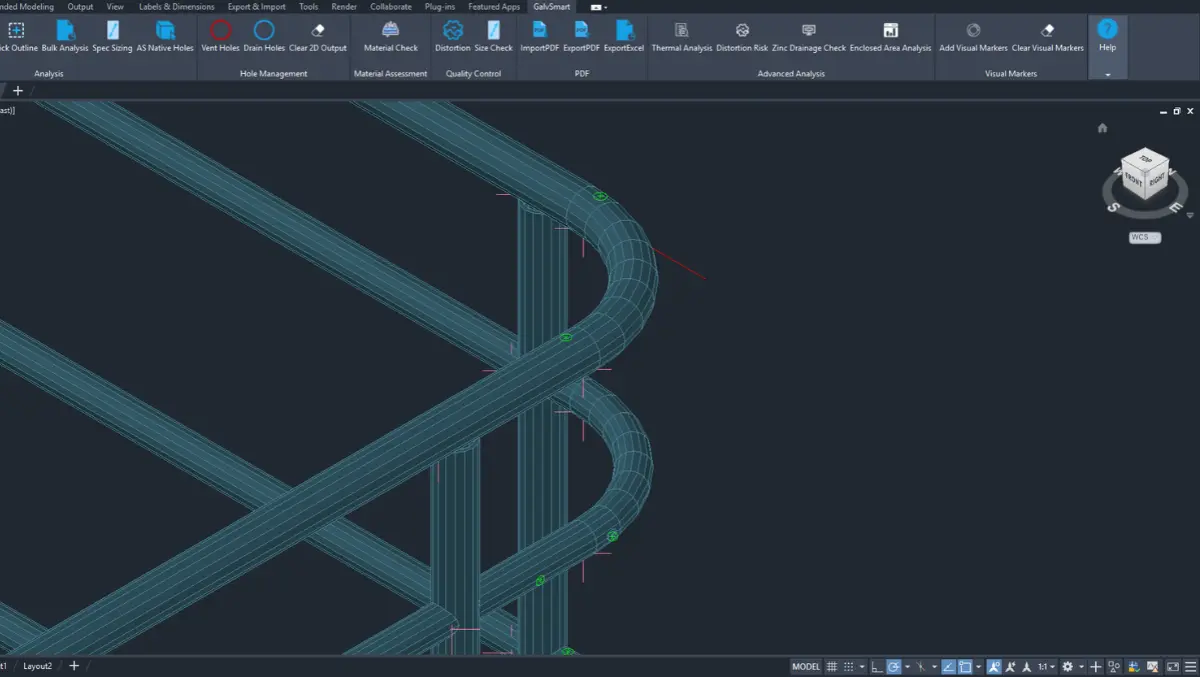

GalvSmart Software has released version 4.0.72 of its AutoCAD and Advance Steel plug-in for planning vent and drain holes in steelwork for hot-dip galvanizing. The update adds French and Spanish editions.
The software identifies sealed steel sections that can create safety risks if they are dipped in molten zinc without the correct openings. In hollow sections such as tubes and box sections, trapped liquid can turn to steam in the galvanising bath, build pressure and burst the steel, the company said.
GalvSmart analyses 3D models to find sealed cavities, including spaces enclosed by several parts, and recommends vent holes at high points and drain holes at low points based on the dip angle set by the detailer. On 2D shop drawings, it identifies outlines that may be hollow sections for the detailer to confirm.
Hole sizes follow tables in ASTM A385 or EN ISO 14713-2, used in North America and Europe. In Advance Steel, the software can write the holes into a model's own beams and plates. Reports can be exported as PDF and Excel files for fabricators to share with galvanisers.
A separate free Revit add-in, GalvSmart Check, lists hollow members in a building model that will require holes before galvanising.
"The holes are a small detail on a drawing and a big problem at the galvanizing plant," said Neil Murray, Founder of GalvSmart Software. "One sealed tube in a batch of hundreds is enough to hurt someone. The rules for where the holes go and how big they must be are published, but applying them by hand to every member of a large model is slow work, and that is when one gets missed.
The language expansion translates the software windows, command prompts, reports and user guide into French and Spanish. Each edition is distributed as a separate download with its own installer.
Murray said the additional languages reflect the company's Canadian base and demand from users in other markets that use the same galvanising standards.
"I am based in Ontario, and a Canadian product that only speaks English is half finished," Murray said. "Fabricators in Quebec and across Latin America work to the same galvanizing standards as everyone else. They should be able to read a warning in their own language, because a safety message that has to be translated in someone's head is easier to miss."
The latest release was tested in AutoCAD versions 2022 to 2027 and in Advance Steel 2022, 2024, 2026 and 2027. Murray said some of the most useful input since launch has come from galvanising plants rather than software users.
That feedback has focused on pieces arriving with one hole missing in a large batch, or hole placement that works for one hanging method but not another. Murray said this leaves plant inspectors as the final check before steel enters the zinc bath.
"Being a one-person company means every piece of feedback lands on my desk," Murray said. "Galvanizers have told me where the real problems are: a piece that arrives with one hole missing in a large batch, or holes that suit one way of hanging the steel but not another. Fabricators do not enjoy drilling hollow sections, and the plant's inspectors are the last line of defence. Getting the holes onto the drawing at the start, sized to a published standard, takes some of that weight off them."